Live Chat
 Log In

We tested 12 providers across speed, reliability, pricing, and support.
Quick Answer
- Best overall for most use cases: Bright Data - the largest residential network (400M+ IPs) with the deepest feature set, at a price that reflects it.
- Best for enterprise-scale scraping: Oxylabs - 175M+ ethically sourced IPs, sub-half-second response times, and granular OS/platform targeting.
- Best value for predictable, high-volume usage: Squid Proxies - real residential IPs starting at $0.75–$1.50/GB, meaningfully cheaper than most of the market, with unified billing across residential and datacenter proxies.
- Best for beginners and budget scraping: Decodo (formerly Smartproxy) - approachable dashboard, 125M+ IPs, starting around $2/GB.
- Best free tier / lowest entry cost: Webshare - 80M+ IPs with a genuinely free tier (10 proxies, 1GB/month, no credit card).
- Best granular geo-targeting: SOAX - city- and ISP-level targeting across 195+ locations.
Below, we explain how we evaluated each provider, a full comparison table, in-depth reviews of twelve providers worth considering in 2026, and a note on a real event this year that every buyer should understand before choosing a residential proxy network.
How We Evaluated These Providers
We compared providers across six criteria that actually affect day-to-day use:
- IP pool size and diversity - how many residential IPs are available, and how they're distributed across subnets and ASNs (a large pool concentrated in a handful of subnets behaves like a small one).
- Geographic coverage - number of countries and cities, and whether you can target down to the state, city, ZIP code, or carrier level.
- Performance - average response time and success rate under real request loads.
- Pricing model and transparency - per-GB, per-IP, or hybrid billing, and how the effective cost scales as your usage grows.
- Ethical sourcing and compliance - whether IPs are gathered through consent-based SDK partnerships and documented acceptable-use policies, or through murkier channels.
- Support, tooling, and ease of setup - dashboard quality, API access, and how responsive support is when something breaks.
We pulled current plan details directly from each provider's pricing page as of August 2026. Pricing and pool sizes in this market change frequently, sometimes because of promotions, sometimes because of events like the one described below, so treat the numbers here as a snapshot and confirm current rates before you buy.
Why Ethical Sourcing Isn't Just a Marketing Line
In July 2026, the FBI and Google jointly disrupted NetNut's residential proxy network after investigators determined a significant portion of its roughly 2-million-device pool was built on compromised consumer devices rather than fully informed, consented participation, reporting described it as functioning like a botnet. NetNut had been a widely used, well-reviewed provider for years before the takedown.
The lesson for buyers isn't that residential proxies are inherently risky, it's that "residential IPs" is a claim, not a guarantee, and the sourcing model behind that claim determines whether you're renting bandwidth from someone who opted in, or unknowingly relying on infrastructure with legal exposure attached. When comparing providers below, we've noted how each one describes its sourcing model. Favor providers that are specific about consent-based SDK partnerships and publish an acceptable-use policy over ones that are vague about where their IPs come from.
Comparison Table
| Provider | Entry Price | IP Pool | Countries | Protocols | Best For |
|---|---|---|---|---|---|
| Bright Data | ~$2.50/GB | 400M+ | ~195 | HTTP(S), SOCKS5 | Largest network, deepest tooling |
| Oxylabs | ~$2.00–$6.00/GB (tiered) | 175M+ | 195+ | HTTP(S), HTTP3, SOCKS5 | Enterprise scale & precision targeting |
| Decodo (Smartproxy) | ~$2.00/GB | 125M+ | ~195 | HTTP(S), SOCKS5 | Easiest onboarding, budget scraping |
| Squid Proxies | $0.75–$1.50/GB | Large pool | US-focused (100+ cities), custom locations on request | HTTP(S) | Predictable, low per-GB cost at volume |
| SOAX | ~$1.50–$2.00/GB | 155M+ | 195+ | HTTP(S), SOCKS5, UDP/QUIC | Granular city/ISP-level targeting |
| Webshare | ~$1.40–$3.50/GB | 80M+ | 195 | HTTP(S), SOCKS5 | Free tier & cheapest entry point |
| IPRoyal | ~$1.75/GB | 64M+ | ~27 | HTTP(S), SOCKS5 | Small teams, pay-as-you-go |
| Rayobyte | ~$3.00/GB | 40M+ | ~27 (US-heavy) | HTTP(S) | US-focused, transparent sourcing |
| DataImpulse | ~$0.80/GB | 90M+ | 195+ | HTTP(S), SOCKS5 | Lowest raw per-GB price |
| ProxyEmpire | ~$1.50/GB | 30M+ | 170+ | HTTP(S), SOCKS5 | Flexible billing options |
| Infatica | ~$2.60/GB | Large rotating pool | 195+ | HTTP(S), SOCKS5 | General-purpose scraping |
| Proxy-Seller | Varies | Mid-size | 220+ | Varies | Budget alternative with location choice |
Pricing and specs are approximate, pulled from public pricing pages, as of September 7, 2026; and subject to change, always verify current terms directly with the provider before buying.
In-Depth Reviews
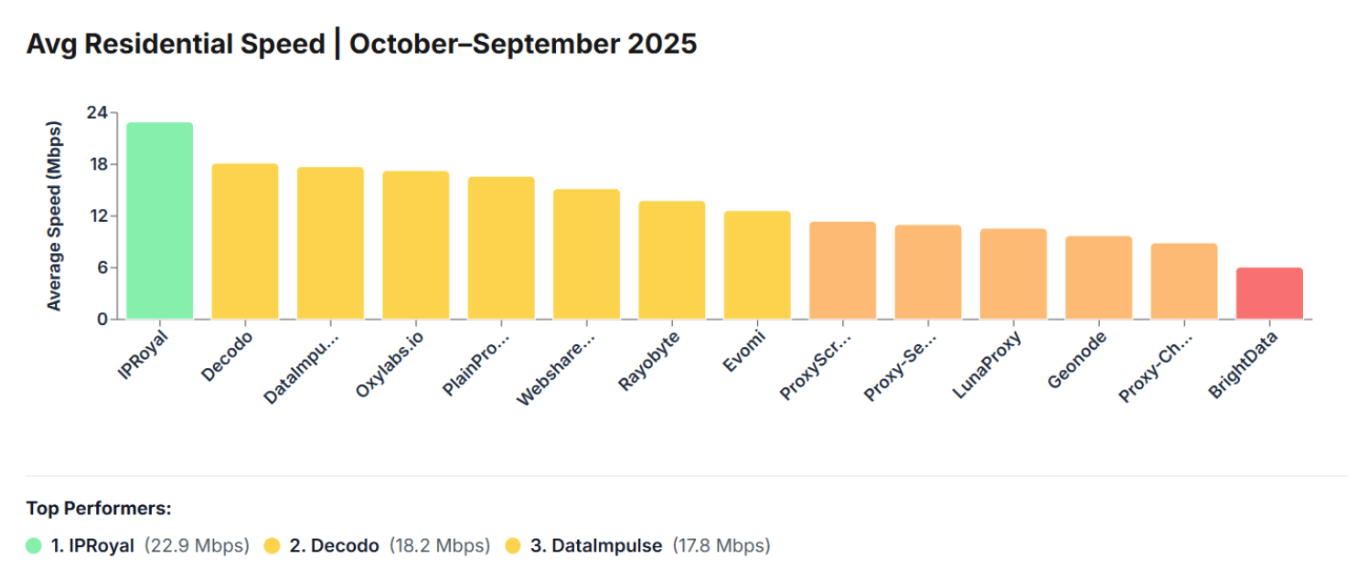
ProxyPerf's residential speed benchmark ranked IPRoyal #1 for average residential proxy speed at 22.9 Mbps for the Oct 2025–Sep 2026 tracking period, ahead of Decodo (18.2 Mbps) and DataImpulse (17.8 Mbps).
1. Bright Data - Best Overall
Bright Data runs the largest residential proxy network in this comparison, with a reported 400M+ IPs across roughly 195 countries. It backs that scale with an extensive tooling ecosystem, a Web Unlocker for hard targets, a Scraping Browser, and SOC 2 Type II compliance, that makes it a common default for enterprise data teams.
Pros: massive, diverse IP pool; mature tooling and integrations; strong compliance credentials. Cons: pricing starts around $2.50/GB and the platform's breadth adds a learning curve; overkill for smaller projects. Best for: large organizations with dedicated engineering resources that need scale and are prepared to pay for it.
2. Oxylabs - Best for Enterprise Scale & Precision Targeting
Oxylabs pairs a 175M+ IP pool with some of the most granular targeting options on the market: country, state, city, ZIP code, coordinates, and ASN, plus OS/platform filtering (Windows, macOS, Android, iOS, Linux). Reported performance is strong: a 0.41-second average response time and 99.95% success rate.
Pros: very precise targeting, high success rates, sticky sessions up to 24 hours, unlimited concurrent sessions. Cons: tiered pricing starts at $6/GB on the entry plan and only drops to roughly $2.50/GB at the 1TB Corporate tier, you pay a premium unless you commit to volume. Best for: teams that need pinpoint geo-targeting and are working at a scale where the volume discounts kick in.
3. Decodo (formerly Smartproxy) - Best for Beginners & Budget Scraping
Decodo offers one of the more approachable entry points into residential proxies, with a 125M+ IP pool, pricing starting around $2/GB, and a dashboard built for users who don't want to spend a week reading documentation before their first request.
Pros: accessible pricing relative to pool size, easy setup, responsive support. Cons: country coverage is solid but not as deep as the largest networks; no SOCKS5 on every plan tier. Best for: teams scraping moderate volumes who want a low learning curve without a huge budget.
4. Squid Proxies - Best Value for Predictable, High-Volume Usage
Squid Proxies has run its own proxy infrastructure for 16+ years and serves over 8,000 clients, historically as a datacenter proxy specialist. It has since built out a dedicated residential proxy network, and the headline difference versus the rest of this list is price: its published residential plans run from $1.50/GB down to $0.75/GB at higher volumes, noticeably below the $2.00–$6.00/GB range most competitors on this page charge before volume discounts.
Plans are structured around bundled proxy count and data:
- 1 proxy / 10GB: $15/mo ($1.50/GB)
- 3 proxies / 30GB: $40/mo ($1.33/GB)
- 10 proxies / 120GB: $120/mo ($1.00/GB)
- 25 proxies / 400GB: $300/mo ($0.75/GB)
- Custom high-volume plans with further per-GB discounts
Squid Proxies markets its residential IPs as sourced from real consumer devices with 5-minute rotation, elite anonymity, and a 99.9% uptime guarantee, and it recently expanded its residential coverage to 100+ U.S. cities, with other locations available on request to its team rather than self-serve from a coverage map. It also lets customers manage residential and datacenter proxies from a single dashboard, which is convenient if you use both.
Pros: meaningfully lower per-GB cost than most competitors at every tier we could verify; long operating history and existing client base; unified billing/management with its datacenter network; no long-term contracts. Cons: no self-serve coverage map, non-U.S. locations require contacting the team directly, which is friction that networks like Bright Data or Oxylabs don't impose; free trials are limited to qualifying business customers rather than open to everyone. Best for: teams running continuous, high-volume residential proxy workloads who've priced out the bigger networks and want a materially lower per-GB rate without switching to a fly-by-night provider.
5. SOAX - Best Granular Geo-Targeting
SOAX's 155M+ IP pool spans 195+ locations with genuine city- and ISP-level precision, backed by a claimed 99.95% success rate and 0.55-second average response time. It supports HTTP(S), SOCKS5, and UDP/QUIC, which is broader protocol coverage than most competitors offer.
Pros: excellent targeting granularity, fast response times, low-commitment trial ($1.99 for a 3-day 400MB test). Cons: per-GB pricing sits in the middle of the pack rather than at the low end; full feature set takes some ramp-up to use well. Best for: use cases, verification, localized SEO tracking, that depend on precise, granular location targeting.
6. Webshare - Best Free Tier & Cheapest Entry Point
Webshare is the rare provider in this category with a genuinely free tier: 10 residential proxies and 1GB of monthly bandwidth with no credit card required. Its paid tiers scale from $3.50/GB down to $1.40/GB at 3,000GB+ of usage, drawing from an 80M+ IP pool across 195 countries with city, state, ZIP, and ASN-level targeting.
Pros: real free tier for testing before you commit; steep volume discounts; 99.97% claimed uptime. Cons: entry-tier per-GB pricing is among the highest on this list before volume discounts kick in. Best for: developers and small teams who want to validate a use case for free before paying for scale.
7. IPRoyal - Best for Small Teams & Pay-As-You-Go
IPRoyal focuses on a smaller but actively-monitored pool of 64M+ residential IPs across roughly 27 countries, with pay-as-you-go pricing around $1.75/GB and no forced monthly subscription for smaller accounts.
Pros: flexible billing without a mandatory subscription, SOCKS5 included, active IP reputation monitoring. Cons: narrower country coverage than the largest networks. Best for: small teams or solo developers who want to buy exactly what they need without committing to a recurring plan.
8. Rayobyte - Best for Transparent, US-Focused Sourcing
Rayobyte leans into deep US coverage with a 40M+ IP pool and has built its reputation partly on being explicit about how it sources residential IPs, which matters more after the NetNut takedown discussed above.
Pros: transparent sourcing practices, strong US targeting, responsive support. Cons: at roughly $3.00/GB it's priced above several competitors with comparable coverage; weaker international reach. Best for: US-centric scraping and monitoring where sourcing transparency is a priority.
9. DataImpulse - Lowest Raw Per-GB Price
DataImpulse undercuts most of the market on headline price, with a 90M+ IP pool and rates around $0.80/GB, competitive with Squid Proxies at the low end, though without the same operating history or unified datacenter/residential management.
Pros: very low entry price relative to pool size, broad country coverage. Cons: newer to the market than most names on this list; success rates in independent tests have trailed the higher-priced providers. Best for: high-volume, cost-sensitive scraping where you can tolerate a somewhat higher failure rate in exchange for price.
10. ProxyEmpire - Most Flexible Billing
ProxyEmpire offers a 30M+ IP pool at around $1.50/GB with billing flexibility, including pay-per-request options, that some competitors don't match.
Best for: teams that want billing structured around actual usage patterns rather than a flat monthly commitment.
11. Infatica - General-Purpose Option
Infatica offers a large rotating residential pool at a mid-market price point (~$2.60/GB) with broad country coverage, positioning it as a general-purpose alternative rather than a specialist in any one dimension.
Best for: teams that want a straightforward, no-frills residential proxy without shopping across a dozen niche features.
12. Proxy-Seller - Budget Alternative With Location Choice
Proxy-Seller is frequently cited for reasonable pricing paired with solid geographic coverage, making it a middle-of-the-road option worth comparing against your specific location needs and budget.
Best for: buyers prioritizing location coverage without paying enterprise prices.
Residential vs. Datacenter vs. Mobile Proxies
| Type | Speed | Detection Risk | Typical Cost | Best For |
|---|---|---|---|---|
| Datacenter | Fastest | Higher (recognizable IP ranges) | Lowest | High-volume scraping, automation, monitoring |
| Residential | Moderate | Low (real ISP-assigned IPs) | Higher | Sites with aggressive anti-bot detection |
| Mobile | Moderate | Lowest | Highest | Ad verification, social media, the toughest targets |
If a target site aggressively fingerprints datacenter IP ranges or you're getting blocked despite rotation, residential proxies are the next step up. If your budget can't stretch to residential rates yet, start with datacenter proxies and reserve residential IPs for the specific targets that need them.
How to Choose the Right Provider
- If cost per GB at real volume is your deciding factor, compare Squid Proxies and DataImpulse directly against your projected monthly usage, both undercut the market's $2+/GB norm.
- If you need maximum raw IP diversity and global reach, Bright Data and Oxylabs lead the category.
- If you're testing an idea on a tight budget, start with Webshare's free tier or SOAX's low-cost trial before committing to a paid plan anywhere.
- If your targets are concentrated in the US, Rayobyte and Squid Proxies both lean into US coverage, though Squid's non-US locations currently require a direct request rather than self-serve targeting.
- If granular city- or ZIP-level targeting is non-negotiable, prioritize Oxylabs or SOAX, both of which support that level of precision out of the box.
- If ethical sourcing is a compliance requirement for your organization, ask every provider, not just the ones on this list, to describe specifically how their residential IPs are obtained, and be wary of vague answers.
Frequently Asked Questions
What is the best residential proxy provider overall? For most use cases needing maximum scale and tooling, Bright Data leads on raw network size. For predictable pricing at high volume, Squid Proxies' $0.75–$1.50/GB rates are meaningfully below the market average. The right answer depends more on your volume and targeting needs than any single "best."
Are residential proxies legal? Yes, using residential proxies is legal in most jurisdictions. What matters more is how the provider sourced its IP pool, informed consent from device owners versus undisclosed or compromised access, and whether your specific use complies with the target site's terms of service.
How much do residential proxies cost? Pricing in 2026 typically ranges from about $0.75/GB to $6/GB depending on the provider, plan tier, and volume commitment. Providers offering unlimited-bandwidth or flat per-IP models are less common in the residential category than in datacenter proxies, where that pricing structure is standard.
Residential vs. datacenter proxies: which should I use? Use datacenter proxies when speed and cost matter most and your targets aren't aggressively blocking data center IP ranges. Move to residential proxies when you're facing persistent blocks despite rotation, or when the target site can distinguish datacenter traffic from real consumer traffic.
How do I know if a residential proxy provider is trustworthy? Ask specifically how the provider sources its IP pool. Providers that can point to a documented, consent-based SDK partnership and a public acceptable-use policy are a safer bet than ones that are vague about sourcing, a distinction that mattered a great deal to former NetNut customers in mid-2026.
Do residential proxies get blocked? Less often than datacenter proxies, since they appear as ordinary consumer traffic, but no proxy type is unblockable. Providers with larger, more diverse pools and active IP health monitoring generally sustain higher success rates over time.
The Bottom Line
There's no single "best" residential proxy provider for every use case, the right pick depends on your budget, targeting precision needs, and how much weight you put on raw pool size versus per-GB cost. Bright Data and Oxylabs remain the category leaders on scale and tooling, at a corresponding price. SOAX and Decodo offer strong middle-ground options for targeting precision and ease of use, respectively. For teams whose primary constraint is cost at real volume, and who want a provider with a long operating history rather than an unproven newcomer, Squid Proxies is worth a direct price comparison against whatever you're paying today; its published rates run meaningfully below what most of this list charges before volume discounts.
Ready to compare residential proxy pricing for your workload? See Squid Proxies' current plans →
- Meta title: Best Residential Proxy Providers in 2026: Top 12 Compared
- Meta description: We compared the top residential proxy providers on pool size, coverage, pricing, and ethical sourcing to help you pick the right one for scraping, automation, and data collection in 2026.
- Primary keyword: best residential proxy providers
- Suggested URL slug: /best-residential-proxy-providers