 Live Chat
 Log In

The Benefits of Rotating Proxies
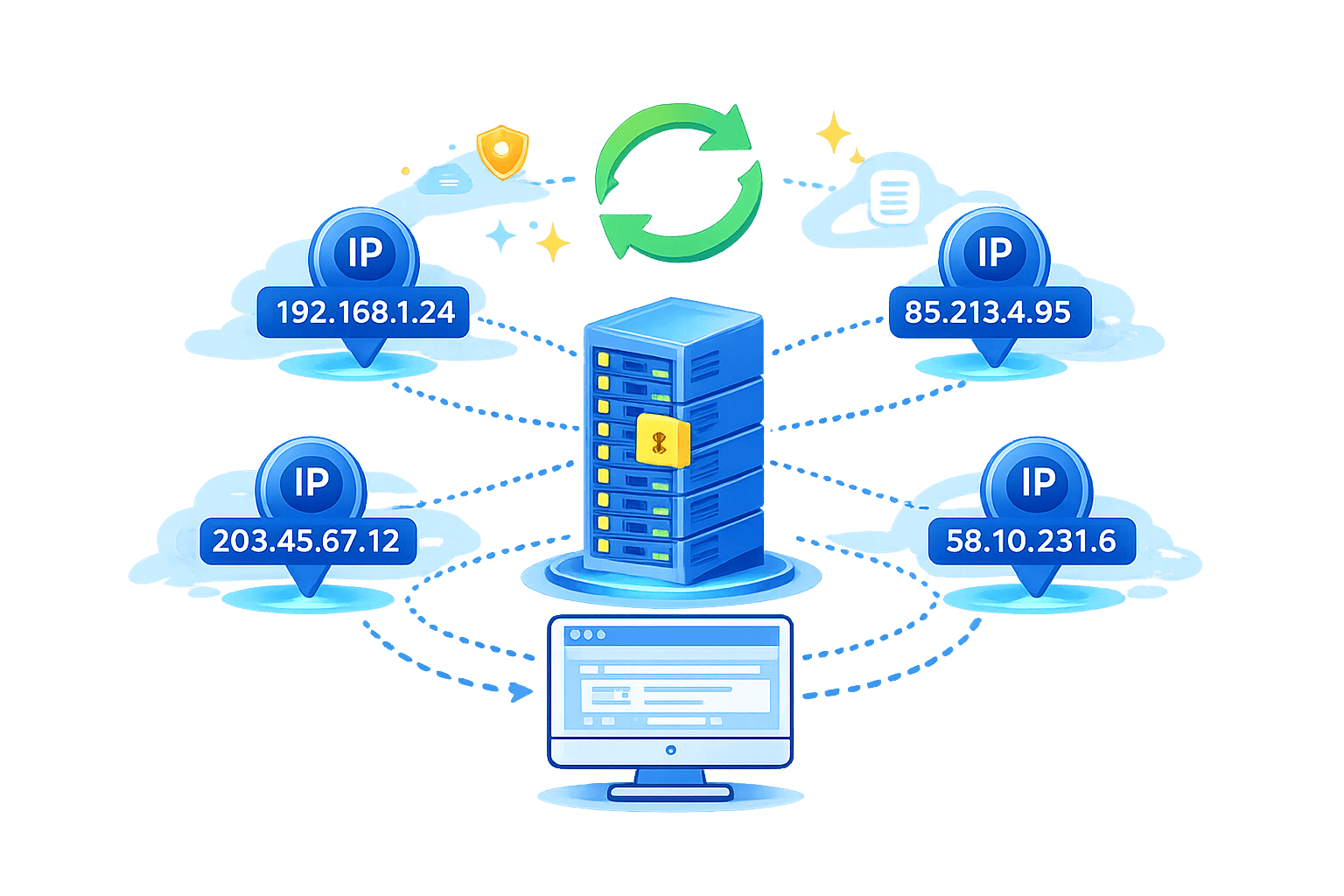
In an online world that increasingly relies on data, access and reliability are everything. Whether you are validating ads across regions, monitoring prices dynamically, or powering large-scale research, the path to clean and consistent data often runs through proxies. Among the options available, rotating proxies have become the go-to solution for teams that need scale, resilience, and compliance without constant firefighting.
This article explains what rotating proxies are, how they work, and why they can transform your data operations. You will learn about the key benefits, practical use cases, and best practices to help you choose and use rotating proxies effectively.
What Are Rotating Proxies
A rotating proxy is a gateway that assigns a different IP address for each request or at set intervals. Instead of sending traffic from a single static IP, your requests are distributed across a pool of IPs. This rotation makes your activity appear as if it is coming from many users in different places, reducing the chance of rate limits, blocks, or CAPTCHAs.
There are two common types of rotating proxy networks:
- Datacenter rotating proxies: Fast and cost-effective, sourced from cloud data centers. Best for speed-sensitive tasks with moderate block risk.
- Residential or mobile rotating proxies: IPs come from real devices or ISPs. Higher trust and success rates on sensitive targets, but generally more expensive.
How Rotation Works
Most providers control an IP pool and a proxy gateway. You connect to a single endpoint, and the gateway handles the rotation policy. Rotation strategies include:
- Every request: A fresh IP on each call for maximum dispersion.
- Session-based: A sticky session keeps the same IP for a set time or number of requests, improving consistency when a site expects statefulness.
- Adaptive rotation: Intelligent switching based on error codes, latencies, or suspected throttling.
Choosing the right rotation strategy depends on your workflow. For example, scraping a list page may work best with per-request rotation, while logging into a dashboard might require sticky sessions.
Key Benefits of Rotating Proxies
1. Higher Success Rates and Fewer Blocks
By spreading requests across many IPs, rotating proxies reduce the appearance of automation or abnormal behavior. Sites that monitor request volume, frequency, or IP reputation are less likely to trigger bans or aggressive CAPTCHAs when traffic is distributed.
2. Enhanced Scalability
Rotation allows you to parallelize tasks without overwhelming a single IP. As your workloads grow, you can increase concurrency while maintaining reliability, which is critical for data collection pipelines and continuous monitoring.
3. Better Geo-Targeting
Access location-specific content by choosing exit nodes in target regions. Rotating proxies let you capture consistent views of localized pricing, search results, and compliance banners. This is essential for market intelligence, SEO, and QA teams verifying regional experiences.
4. Improved Data Quality
Fewer blocks and fewer CAPTCHAs mean more consistent datasets and lower rates of missing or partial results. With rotating proxies, you spend less time handling retries and exception logic and more time analyzing complete, trustworthy data.
5. Operational Resilience
IP addresses can be burned through repeated use. Rotation spreads the load and refreshes addresses automatically, reducing the maintenance burden. If a subset of IPs is flagged, the pool can route around issues with minimal disruption.
6. Privacy and Risk Reduction
Separating your infrastructure from target-facing IPs limits your exposure and reduces the chance of network-level profiling. This is especially helpful for sensitive competitive intelligence and compliance validation tasks.
7. Cost Efficiency Over Time
While rotating proxy plans can seem pricier upfront, they often lower total ownership costs. Fewer blocks mean less developer time fixing brittle scripts, fewer emergency vendor changes, and less wasted compute on failed requests.
Common Use Cases
- Web scraping and data collection: Product catalogs, reviews, availability, and news aggregation at scale.
- SEO monitoring: Rank tracking, SERP analysis, and content verification across regions and devices.
- Ad verification: Confirm placements, detect spoofing, and validate compliance for different geographies.
- Price and inventory intelligence: Monitor competitors, dynamic pricing, and stock levels in near real-time.
- QA and localization testing: Validate site behavior for users in different countries and networks.
Always ensure your use case complies with relevant laws, target site terms, and ethical guidelines.
Best Practices for Using Rotating Proxies
- Match rotation to the task: Use sticky sessions for login or cart flows and per-request rotation for list and detail pages.
- Respect crawl etiquette: Honor robots.txt where applicable, set reasonable request intervals, and avoid overwhelming targets.
- Randomize patterns: Vary headers, user agents, and navigation paths to mimic real browsing and reduce fingerprinting.
- Implement smart retries: Back off on HTTP 429 and 5xx errors, and rotate IPs on failures to avoid escalating blocks.
- Cache strategically: Cache stable assets and unchanged responses to reduce traffic and costs.
- Monitor and alert: Track success rates, latency, error codes, and IP reputation signals. Use dashboards and alerts to spot trends early.
- Secure credentials: Rotate proxy auth tokens, use encrypted connections, and audit access for your team and systems.
Choosing the Right Provider
When evaluating rotating proxy providers, look beyond the price per gigabyte. Consider:
- Pool size and diversity: Larger, fresher pools improve resilience and geo coverage.
- IP types: Datacenter vs residential vs mobile, depending on your targets and sensitivity levels.
- Geo distribution: Country and city-level targeting with reliable availability.
- Session control: Fine-grained session persistence and customizable rotation policies.
- Performance: Consistent speeds, low latency, and stable throughput under load.
- Compliance posture: Clear acceptable use policies, KYC where appropriate, and transparent sourcing of IPs.
- Tooling and support: APIs, SDKs, dashboards, logs, and responsive support for troubleshooting.
- Reporting and billing clarity: Granular usage metrics, predictable plans, and alerting on quotas.
Run a proof of concept with realistic workloads before committing. Validate success rates, page completeness, and the behavior of your most challenging targets.
Compliance and Ethics
Rotating proxies are powerful, and with power comes responsibility. Follow these principles:
- Legal compliance: Adhere to applicable laws, including data protection and computer misuse statutes.
- Respect terms and robots: Review site terms of service and robots.txt. Obtain permission where required.
- Protect personal data: Avoid collecting or storing sensitive personal information unless you have a lawful basis and safeguards.
- Limit impact: Throttle requests and avoid behaviors that degrade service for others.
Building ethical guardrails not only mitigates risk but also preserves access for the broader ecosystem.
FAQs
- Are rotating proxies always better than static proxies? Not always. Static proxies are fine for predictable, low-volume tasks or whitelisted integrations. Rotating proxies shine at scale and in sensitive or geo-specific workflows.
- Will rotating proxies eliminate CAPTCHAs? No solution can guarantee that, but rotation reduces the frequency and improves success rates when combined with responsible crawling and fingerprint hygiene.
- Do I need residential IPs? Use residential or mobile IPs for higher trust sites or where datacenter IPs are frequently blocked. For speed and cost efficiency, datacenter IPs can be sufficient on less sensitive targets.
Conclusion
Rotating proxies turn fragile, manual data collection into a sustainable, scalable operation. By distributing requests across diverse IPs, you gain higher success rates, stronger geo coverage, better data quality, and lower long-term costs. Pair the right rotation strategy with responsible crawling, careful provider selection, and clear compliance practices, and you will have a robust foundation for reliable, ethical data-driven work.
Related Articles

Rotating vs Static Proxies: Performance Tradeoffs
A practical, decision-focused guide comparing rotating and static proxies. Learn how each impacts success rate, block rate, latency, cost, and data quality. Includes a selection framework, tuning tips, failure modes, and measurable metrics for scraping, automation, and analytics teams.

Mobile Proxies vs Residential Proxies: A Practical Buying and Build Guide
A hands-on comparison of mobile vs residential proxies for scraping, ads, and automation. Learn when to use each, how they work, what to measure, failure modes, and a decision framework to cut block rates and improve ROI.
ISP Proxies Explained: When to Use Them
A practical, decision-focused guide to ISP proxies. Learn what they are, where they outperform residential and datacenter proxies, key trade-offs, deployment tips, metrics to track, and real-world scenarios.