 Live Chat
 Log In

Building AI Training Pipelines with Proxy Infrastructure
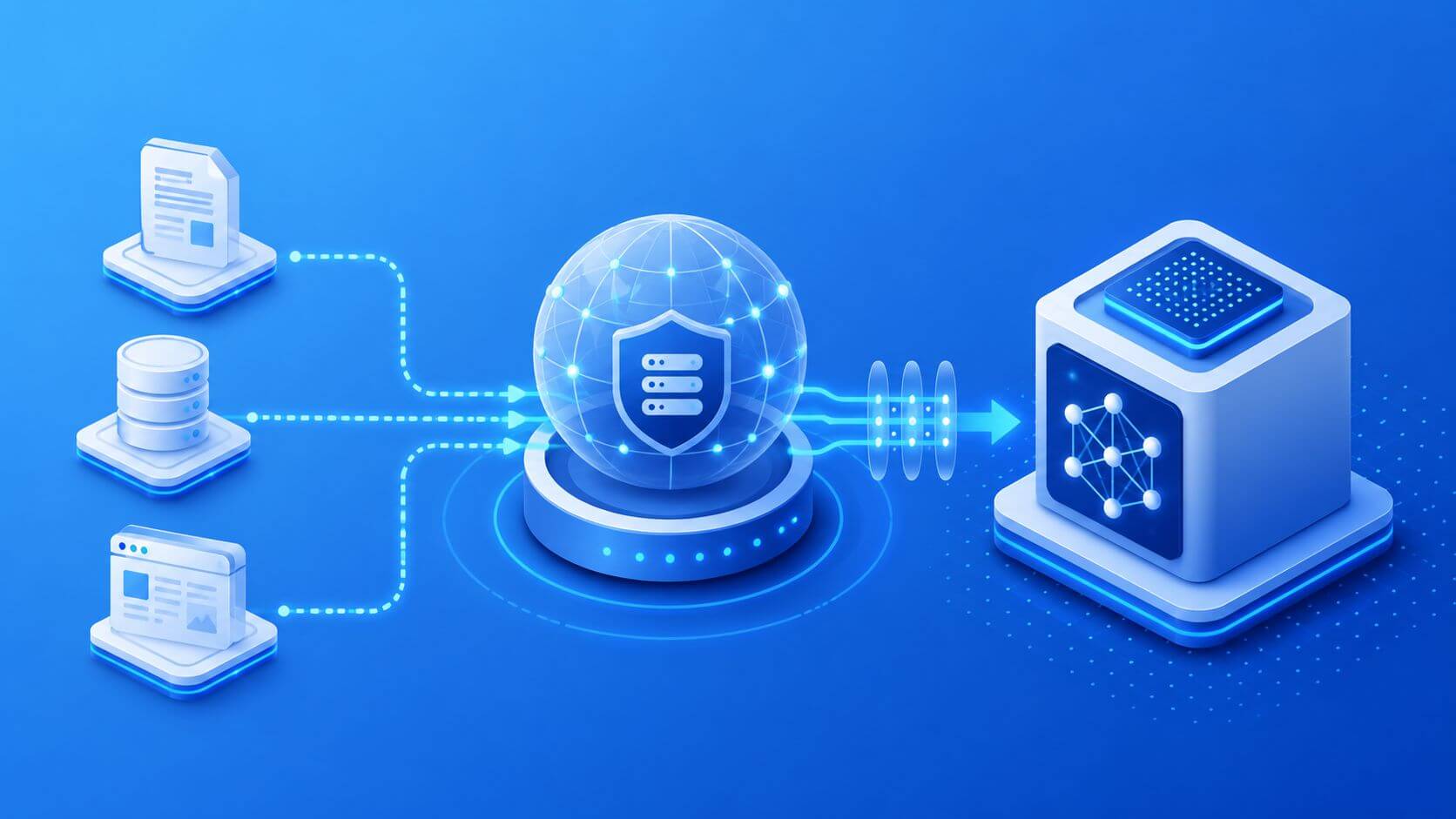
AI models depend on fresh, diverse, and representative data. When training data becomes stale, region-limited, duplicated, or biased toward a narrow source set, model quality suffers. At the same time, large-scale data collection can run into rate limits, geo restrictions, blocked sessions, inconsistent responses, and incomplete datasets.
That is where proxy infrastructure becomes part of the AI data pipeline. For teams collecting public web data, monitoring regional content, or refreshing datasets for model training, proxies for data for AI can help improve coverage, reduce collection gaps, and support more reliable data operations when used responsibly.
Building AI training pipelines with proxy infrastructure means designing the collection layer so requests are routed through the right IP type, region, session policy, and validation rules for each source. The goal is not simply to collect more data. The goal is to collect usable, compliant, well-labeled, and repeatable data at a predictable cost.
Why Proxy Infrastructure Matters for AI Training Data
AI training pipelines fail when the data layer is unreliable.
Common problems include:
- missing records from blocked requests
- biased datasets from limited geographic coverage
- stale content because crawls cannot finish on schedule
- duplicate or malformed records from retry-heavy collection
- inconsistent pricing, language, or regional content
- rising infrastructure spend without better data quality
A proxy layer helps by giving the data collection system more control over network identity, location, session continuity, and request distribution.
For example, a model trained on eCommerce product data may need prices, availability, descriptions, reviews, and category structures from multiple regions. If all collection comes from one country, the dataset may miss localized prices, shipping rules, regional product names, or availability differences.
Using a structured proxy strategy allows teams to collect more representative data while monitoring success rate, block rate, geo accuracy, and cost per successful request.
What an AI Training Pipeline Looks Like
A production AI training pipeline usually has several stages:
- Source discovery — identify domains, feeds, APIs, pages, or datasets.
- Collection — fetch data through HTTP clients, browser automation, or approved APIs.
- Validation — check schema, completeness, language, region, and duplication.
- Cleaning — normalize fields, remove noise, deduplicate, and filter sensitive data.
- Labeling or enrichment — add categories, entities, tags, embeddings, or metadata.
- Versioning — store snapshots so model training can be reproduced.
- Training and evaluation — feed curated data into model workflows.
- Monitoring — track drift, quality, freshness, and pipeline reliability.
Proxy infrastructure sits mostly in the collection layer, but it affects everything downstream. If collection is unstable, every later stage becomes more expensive.
Core Architecture for Proxy-Aware AI Data Pipelines
A strong architecture separates collection logic from proxy routing logic.
A practical system includes:
- Scheduler — decides crawl frequency, priority, and collection windows.
- Fetcher layer — uses HTTP clients, web scraping proxies, or browser automation.
- Proxy manager — chooses proxy type, region, rotation policy, and session rules.
- Domain policy registry — stores allowed routes, concurrency limits, and compliance notes.
- Validation layer — checks whether the returned data is complete and usable.
- Storage layer — saves raw and processed data with timestamps and lineage.
- Monitoring layer — tracks success rate, block rate, latency, retry depth, and CPSR.
A simplified flow looks like this:
Scheduler
   ↓
Domain Policy
   ↓
Fetcher / Browser Worker
   ↓
Proxy Manager
   ↓
Target Source
   ↓
Validation
   ↓
Storage + Lineage
   ↓
Training Dataset
The proxy manager should not randomly rotate IPs without context. It should make routing decisions based on domain, workload type, region, session requirements, cost, and recent failure history.
Choosing the Right Proxy Type for AI Data Collection
Different data collection jobs require different proxy types.
Datacenter proxies are often a good fit for high-volume collection from lower-friction public pages. They are fast, predictable, and cost-efficient when targets do not require consumer-like network signals.
Residential proxies are better suited for geo-sensitive, dynamic, or consumer-facing pages where network identity affects what content is returned.
A practical proxy selection guide:
| Workload | Recommended Proxy Type | Why |
|---|---|---|
| Public static pages | Datacenter proxies | Fast and cost-efficient |
| Product catalogs | Datacenter first, residential fallback | Keeps cost low while preserving coverage |
| Localized pricing | Residential proxies | Better for region-specific results |
| Travel or marketplace data | Residential proxies | Helps with dynamic, geo-sensitive content |
| Multi-step browsing flows | Sticky residential sessions | Maintains session continuity |
| High-friction sources | Residential or carefully controlled browser sessions | Improves success on sensitive pages |
| API-like endpoints | Datacenter or direct approved access | Lower cost and simpler routing |
The best approach is usually hybrid. Use the lowest-cost route that returns valid data, then escalate only when metrics show it is necessary.
When Proxy Infrastructure Helps—and When It Does Not
Proxy infrastructure helps when the problem is related to network access, IP reputation, region, or session routing.
Use proxies when:
- sources return different data by country or city
- crawls are rate-limited by IP
- content is localized by region
- sessions need to remain stable across pagination
- collection jobs need diversified network routes
- one proxy type works for some domains but not others
Proxies do not solve every data pipeline issue.
They will not fix:
- poorly written extractors
- broken parsers
- invalid schemas
- duplicate records
- missing consent or policy approval
- browser fingerprint problems by themselves
- low-quality labels
- biased source selection
This distinction matters. Proxies improve access and routing, but dataset quality still depends on validation, cleaning, governance, and source design.
Routing Strategy: How to Control Cost and Reliability
Proxy routing should be policy-driven.
Instead of applying one global rule across every source, define routing rules by domain and workload.
A strong routing policy may include:
- proxy type
- target GEO
- concurrency limit
- session duration
- retry budget
- failover rules
- browser or HTTP client preference
- compliance status
- validation requirements
Example policy:
| Domain Type | Proxy Route | Session Rule | Retry Rule |
|---|---|---|---|
| Public catalog | Datacenter | Short session | Retry twice with backoff |
| Localized PDP | Residential by GEO | Sticky 5–15 minutes | Retry same region |
| Login-based source | Residential | One session per identity | No aggressive retries |
| High-friction source | Residential + browser | Sticky session | Cooldown after challenge |
| API-approved source | Direct/API | N/A | Respect API limits |
This keeps the system from overusing expensive routes where cheaper ones already work.
Session Strategy for Training Data Pipelines
AI data collection often involves repeated visits to the same source over time. Session design affects both success rate and data consistency.
Use sticky sessions when:
- pages are paginated
- filters or search state must persist
- the workflow spans multiple steps
- localized content must remain consistent
- cookies affect the returned data
Use rotation when:
- pages are independent
- the workload is stateless
- sources rate-limit by IP
- each request can be validated separately
Avoid rotating IPs in the middle of a multi-step workflow. That can break session continuity and cause inconsistent results.
For deeper implementation patterns, SquidProxies proxy tutorials can help teams connect proxy setup with real collection workflows.
Geo Accuracy and Dataset Bias
Geo accuracy is critical when training models on localized content.
If your pipeline intends to collect German pricing, the proxy route, browser timezone, language, currency, and returned content should all match that target region.
Validate geo accuracy with multiple signals:
- proxy IP location
- page language
- currency
- shipping region
- localized banners
- content-language headers
- country-specific URLs
- region-specific product availability
Do not assume that an IP location alone proves the content is correct. A page may return a generic version, fallback content, or mixed-region results.
Geo validation prevents hidden dataset bias.
Browser Automation in AI Training Pipelines
Not every AI data pipeline needs browser automation. For static HTML or API-like sources, lightweight HTTP clients are faster and cheaper.
Use browser automation when:
- content renders through JavaScript
- page state affects returned data
- interactions are needed
- content appears after scrolling or filtering
- HTTP clients return incomplete data
- browser behavior affects localization
Tools such as Playwright, Puppeteer, and Selenium can support browser-based collection, but they should be used selectively.
Browsers increase compute cost. Use them where they improve valid output, not everywhere by default.
Compliance and Responsible Data Collection
AI training pipelines need governance from the beginning.
A responsible collection process should:
- respect applicable laws and platform terms
- avoid bypassing access controls
- follow internal review requirements
- minimize collection of unnecessary personal data
- filter or remove sensitive data early
- maintain source-level audit logs
- document collection purpose and retention rules
- prefer official APIs, feeds, or partnerships where available
For broader allowed-use planning, map each pipeline to clear proxy use cases and maintain a domain policy registry.
A domain policy registry should record:
- source name
- allowed collection method
- approved frequency
- data fields collected
- compliance notes
- proxy route
- retention rules
- owner or reviewer
This makes the pipeline easier to audit and safer to scale.
What to Measure in Proxy-Aware AI Pipelines
The most important metrics connect infrastructure performance to data quality.
| Metric | Why It Matters |
|---|---|
| ----------------- | |
| Success rate | Measures completed, valid responses |
| Block rate | Tracks access friction and routing issues |
| Soft block rate | Catches pages that load but return unusable data |
| CPSR | Shows true cost per successful result |
| Retry depth | Reveals hidden instability |
| Geo accuracy | Confirms region-specific data quality |
| Latency | Affects throughput and freshness |
| Duplicate rate | Shows collection or normalization problems |
| Schema pass rate | Measures downstream usability |
| Dataset freshness | Confirms training data is current |
CPSR means cost per successful request.
In plain terms: CPSR tells you how much each usable record costs after proxy spend, browser compute, bandwidth, retries, and failed requests.
A more expensive proxy route may still lower CPSR if it reduces retries and improves valid output.
Cost Control: Avoid Overbuilding the Pipeline
A common mistake is using premium infrastructure for every source.
Instead, tier the pipeline:
- Use direct APIs or approved feeds where available.
- Use HTTP clients for static or low-friction pages.
- Use datacenter proxies for scalable public collection.
- Use residential proxies for dynamic or geo-sensitive pages.
- Use browser automation only where rendering is required.
- Use stricter session controls only for high-value workflows.
This layered approach keeps cost aligned with difficulty.
Real-World Scenario: ECommerce Product Embeddings
An AI team builds product embeddings from catalog pages, descriptions, specs, and reviews.
Most product list pages are accessible with datacenter proxies and simple HTTP clients. Product detail pages are more dynamic and sometimes return localized pricing.
The team routes list pages through datacenter proxies and sends localized product detail pages through residential proxies by region. Browser rendering is used only for pages where important fields are missing from HTML.
The result is better coverage without moving the entire collection system to expensive routes.
Real-World Scenario: Travel Fare Forecasting
A travel data team collects fares across multiple countries and time windows.
The original pipeline returns inconsistent prices because some pages serve fallback content when geo signals do not match.
The team introduces residential proxies by region, aligns browser timezone and language, validates currency, and logs geo markers per response.
The model receives cleaner regional data, and the team can separate real market differences from collection artifacts.
Failure Modes to Watch For
Hidden Blocks
Some sites return status 200 but serve empty, generic, or challenge content. Validate content, not just HTTP status.
Retry Storms
Unbounded retries increase cost and may worsen blocking. Use backoff and retry limits.
Geo Mismatch
The proxy may point to one region while the content reflects another. Validate returned content fields.
Over-Rotation
Rotating too often can break pagination, cookies, and session continuity.
Duplicate Records
Repeated retries and URL variations can inflate datasets. Use stable IDs, canonical URLs, and content hashes.
Source Bias
Collecting from easy-to-access domains only can bias training data. Track source distribution and coverage.
Frequently Asked Questions
What does it mean to build AI training pipelines with proxy infrastructure?
It means using managed proxy routing, session controls, and location-aware access as part of the data collection layer for AI training datasets. The goal is reliable, compliant, and diverse data collection at predictable cost.
Do AI training pipelines always need proxies?
No. Use official APIs, licensed datasets, direct feeds, or public downloads when they are available and appropriate. Proxies are useful when collection requires location control, IP distribution, or session stability.
Which proxy type is best for AI data collection?
Datacenter proxies are often best for high-volume public pages. Residential proxies are better for dynamic, localized, or consumer-facing content. The right proxy depends on success rate, block rate, geo accuracy, and CPSR.
How do proxies improve AI training data quality?
They can improve coverage, reduce missing data, support regional collection, and help refresh datasets on schedule. They do not replace validation, cleaning, labeling, or compliance controls.
How do I avoid collecting biased data?
Track source coverage, geographic distribution, language coverage, duplicate rate, and freshness. Validate that the returned content matches the intended region or source category.
Should I use browser automation for AI data collection?
Use browser automation only when it improves valid output. If HTTP clients return complete and reliable data, they are usually cheaper and faster.
What should I measure before scaling?
Measure success rate, block rate, soft block rate, CPSR, retry depth, geo accuracy, schema pass rate, duplicate rate, and dataset freshness.
How do I keep the pipeline compliant?
Maintain a domain policy registry, document collection purpose, filter sensitive data early, respect applicable laws and terms, and prefer approved access methods where available.
Final Thoughts
AI training pipelines are only as reliable as their data collection layer. Proxy infrastructure helps teams improve coverage, stabilize access, control geographic sampling, and reduce missing data when used responsibly.
The strongest systems do not rely on random rotation or one-size-fits-all proxy rules. They use policy-driven routing, domain-level controls, session-aware collection, strong validation, and clear metrics.
Start with the cheapest responsible route that returns valid data. Escalate only when success rate, geo accuracy, or CPSR proves the need. For teams planning larger deployments, review SquidProxies proxy plans and pricing to match proxy infrastructure with workload size, data quality goals, and operational budget.
Related Articles
AI Agents and Browser Automation: Infrastructure Requirements
A practical guide to designing, scaling, and monitoring infrastructure for AI agents and browser automation, with decision frameworks, metrics, and failure-mode defenses.
Collecting Public Web Data for LLM Training: A Practical Playbook
A practical, measurable guide to collect public web data for LLM training—covering architecture, proxies, quality controls, metrics, risk, and a 30-day pilot plan.