 Live Chat
 Log In

Browser Fingerprinting Explained for Scrapers

A scraper can use good proxies, clean headers, and careful pacing, yet still get blocked because the browser itself looks wrong. That is where browser fingerprinting becomes important. For scraping teams, understanding browser fingerprinting helps explain why some sessions fail even when the IP layer appears healthy.
Browser fingerprinting is the process of identifying a browser based on technical signals such as user agent, screen size, fonts, canvas output, WebGL, timezone, language, WebRTC, and device settings. For scrapers, the goal is not to hide every signal. The goal is to make browser behavior consistent, realistic, and aligned with the proxy route.
Why browser fingerprinting matters for scraping
Modern websites do not evaluate traffic through IP address alone. They often combine network signals, browser signals, behavior signals, and session history.
This means a scraper using web scraping proxies can still fail if its browser identity is inconsistent. For example, a session may use a residential IP in Germany while the browser reports a US timezone, English-only language settings, and a WebRTC leak from another region.
That mismatch may not always cause an immediate block. However, it can raise risk signals, trigger CAPTCHA, produce soft blocks, or return wrong localized content.
What browser fingerprinting means in simple terms
A browser fingerprint is a collection of technical details that helps a website recognize or score a browser session.
These details may include:
- user agent
- browser version
- operating system
- screen size
- installed fonts
- timezone
- language
- canvas rendering
- WebGL output
- audio signals
- WebRTC behavior
- hardware concurrency
- device memory
- cookie and storage behavior
Individually, these signals may look normal. Combined, they can create a profile that appears common, rare, suspicious, or inconsistent.
For scrapers, the practical question is not “Can the site fingerprint me?” The better question is “Does my browser identity match the rest of my session?”
Browser fingerprinting vs proxy detection
Proxy detection and browser fingerprinting are related, but they are not the same.
A proxy changes the network path. A browser fingerprint describes the browser environment.
| Layer | What it reveals | Example issue |
|---|---|---|
| Proxy layer | IP, ASN, location, network type | Datacenter IP on a site expecting consumer traffic |
| Browser layer | Device, browser, rendering, system settings | Headless browser with unusual defaults |
| Session layer | Cookies, storage, login state | Returning user with mismatched location |
| Behavior layer | Timing, clicks, navigation path | Perfectly repeated actions across sessions |
This is why residential proxies can help with trust signals, but they do not automatically fix browser-level issues. A strong setup aligns both layers.
Common fingerprint signals scrapers should understand
User agent
The user agent tells the website what browser, version, and operating system the request claims to use.
A suspicious setup may claim to be Chrome on Windows while other signals look like Linux automation. The user agent should match the actual browser environment as closely as possible.
Timezone and language
Timezone and language are simple but important.
If your proxy exits in France, but the browser timezone is set to a US region and the language is English-only, the session may look inconsistent. For geo-sensitive scraping, this can also return the wrong content.
Screen size and viewport
Viewport size affects how pages render.
Scrapers often use default viewport values that repeat across many sessions. That can be acceptable for low-risk pages, but it may look unnatural at scale if every session has the same size.
Canvas and WebGL
Canvas and WebGL are browser rendering signals. Websites may use them to observe how a device draws graphics.
These signals are useful because they can vary across hardware, drivers, operating systems, and browsers. Poorly configured browser automation may produce unusual or repeated outputs.
WebRTC
WebRTC can expose local or network-related information if not controlled.
For scraping teams, the risk is leakage. A browser may use a proxy but still reveal network details that do not align with the proxy location. This is why WebRTC handling matters in browser-based scraping.
Cookies and storage
Cookies, local storage, and session storage are part of identity.
If a scraper rotates IPs too often while keeping the same cookies, the session may become suspicious. If it clears cookies too often, it may look like a new user every time.
When browser fingerprinting becomes a real problem
Browser fingerprinting matters most when the target is sensitive, account-based, or geo-aware.
It becomes more important for:
- login-based scraping
- travel and marketplace data
- localized eCommerce pricing
- ad verification
- social media workflows
- SEO rank tracking by region
- high-value pages with anti-bot systems
- browser automation using Selenium, Playwright, or Puppeteer
It matters less for simple public pages that serve the same content to everyone and do not apply strict filtering. In those cases, proxy routing, concurrency, and content validation may matter more.
Headless browsers and fingerprint consistency
A headless browser runs without a visible graphical interface. Tools like Selenium, Puppeteer, and Playwright often use headless mode for speed and automation.
Headless mode is useful, but default settings can create detectable patterns. The problem is not simply that headless browsers exist. The problem is when the browser reports a combination of signals that few real users would produce.
For teams using Puppeteer, fingerprint consistency should be part of production planning. The proxy, viewport, timezone, language, cookies, and browser context should all support the same session story.
A practical decision framework for scrapers
Use this framework before investing too much time in fingerprint tuning.
| Situation | Fingerprint priority | Recommended action |
|---|---|---|
| Static public pages | Low | Focus on proxy routing and retries |
| JavaScript-rendered pages | Medium | Stabilize browser contexts and validate content |
| Geo-sensitive pages | High | Align proxy, timezone, language, and locale |
| Login-based workflows | High | Use stable sessions and consistent browser identity |
| Social or marketplace automation | Very high | Combine proxy quality, profile isolation, and session warm-up |
| Repeated CAPTCHA or soft blocks | High | Audit browser signals and route design |
This keeps teams from overengineering fingerprint controls on easy targets while still treating sensitive workflows carefully.
How to reduce fingerprint-related failures
Keep session signals aligned
The browser should tell a consistent story.
If the proxy is in the UK, use a reasonable timezone, language, and locale for that region. If the session belongs to a returning account, avoid sudden location or device shifts.
Avoid unnecessary randomization
Randomizing every signal can make the session look less natural.
Real users do not change device memory, WebGL output, timezone, and screen size every few minutes. Consistency often matters more than constant variation.
Use separate browser contexts
A browser context is an isolated browser environment with its own cookies and storage.
Use separate contexts for different accounts, regions, or tasks. This helps prevent cross-contamination between sessions.
Validate content, not just status codes
A fingerprint-related issue may not return a hard block.
The page may load but show missing prices, incorrect region, limited results, or a challenge page. Treat those as failures, even if the HTTP response looks successful.
Match proxy type to target friction
Sensitive workflows often need stronger network identity.
If a target reacts poorly to server-side IP ranges, datacenter proxies may still work for discovery but not for final extraction. Segment the workflow instead of forcing one route everywhere.
What to monitor in production
Browser fingerprinting problems are hard to fix if you do not label them correctly.
Track these signals:
- CAPTCHA rate
- soft block rate
- geo mismatch rate
- session survival
- login reset frequency
- content validation failure
- retry depth
- block rate by proxy type
- CPSR
CPSR means cost per successful request.
In plain terms: CPSR shows how much each valid output costs after retries, browser compute, and proxy spend.
If fingerprint tuning lowers CAPTCHA but increases latency and compute cost too much, evaluate the net effect. The best setup is the one that produces valid data reliably at a sustainable cost.
Watch out for these fingerprint mistakes
Changing too many signals at once
More randomization does not always mean more realism. Too much variation can create unstable sessions.
Using one browser profile for many accounts
Shared cookies and storage can connect sessions that should remain separate.
Rotating proxies without adjusting locale
If location changes but browser settings stay fixed, the session may look inconsistent.
Ignoring WebRTC behavior
A proxy cannot help if the browser leaks network details that contradict the route.
Treating all blocks as proxy failures
Some blocks come from browser identity, not IP reputation. Diagnose before changing the proxy pool.
Where anti-detect browsers fit
Anti-detect browsers are tools designed to manage multiple browser profiles with controlled fingerprints.
They can be useful for multi-account workflows, ad verification, affiliate testing, and sensitive browser automation. However, they are not a replacement for good proxy routing or responsible scraping practices.
For teams comparing identity-management tools, the Incogniton review 2026 provides a useful example of how browser profiles, proxies, and team workflows fit together.
Frequently Asked Questions
What is browser fingerprinting in web scraping?
Browser fingerprinting is the process of identifying or scoring a browser based on technical signals like user agent, screen size, timezone, fonts, canvas, WebGL, WebRTC, and storage behavior. In scraping, it matters because browser automation can expose patterns that normal HTTP proxy rotation does not fix.
Do proxies prevent browser fingerprinting?
No. Proxies change the network identity, but browser fingerprinting evaluates the browser environment. A strong setup aligns both the proxy route and the browser signals.
Is headless browsing easier to detect?
It can be if the browser uses unusual defaults or inconsistent settings. The goal is not simply to avoid headless mode, but to make the browser context consistent with the session, proxy location, and target workflow.
What fingerprint signals matter most for scrapers?
The most practical signals are user agent, timezone, language, viewport, WebRTC, cookies, canvas, WebGL, and storage behavior. The importance depends on the target’s sensitivity.
Should scrapers randomize fingerprints?
Randomization should be controlled. Constantly changing many signals can look less natural than using stable, coherent profiles. Match the fingerprint strategy to the workflow.
How do I know if fingerprinting is causing blocks?
Look for CAPTCHA, soft blocks, geo mismatch, login resets, and failures that persist even after proxy changes. Compare results across browser contexts, proxy types, and regions to isolate the cause.
Final thoughts
Browser fingerprinting matters because scraping is no longer only about IP rotation. The browser, session, proxy, and behavior layer all contribute to whether the workflow succeeds.
For simple pages, fingerprint tuning may not be the first priority. For login-based, geo-sensitive, JavaScript-heavy, or high-friction targets, it can be the difference between stable data and repeated failures.
The best approach is practical: align browser signals with proxy routes, keep sessions consistent, avoid unnecessary randomization, and measure valid output. From there, use deeper SquidProxies guides and technical resources to refine the setup as target behavior changes.
Related Articles
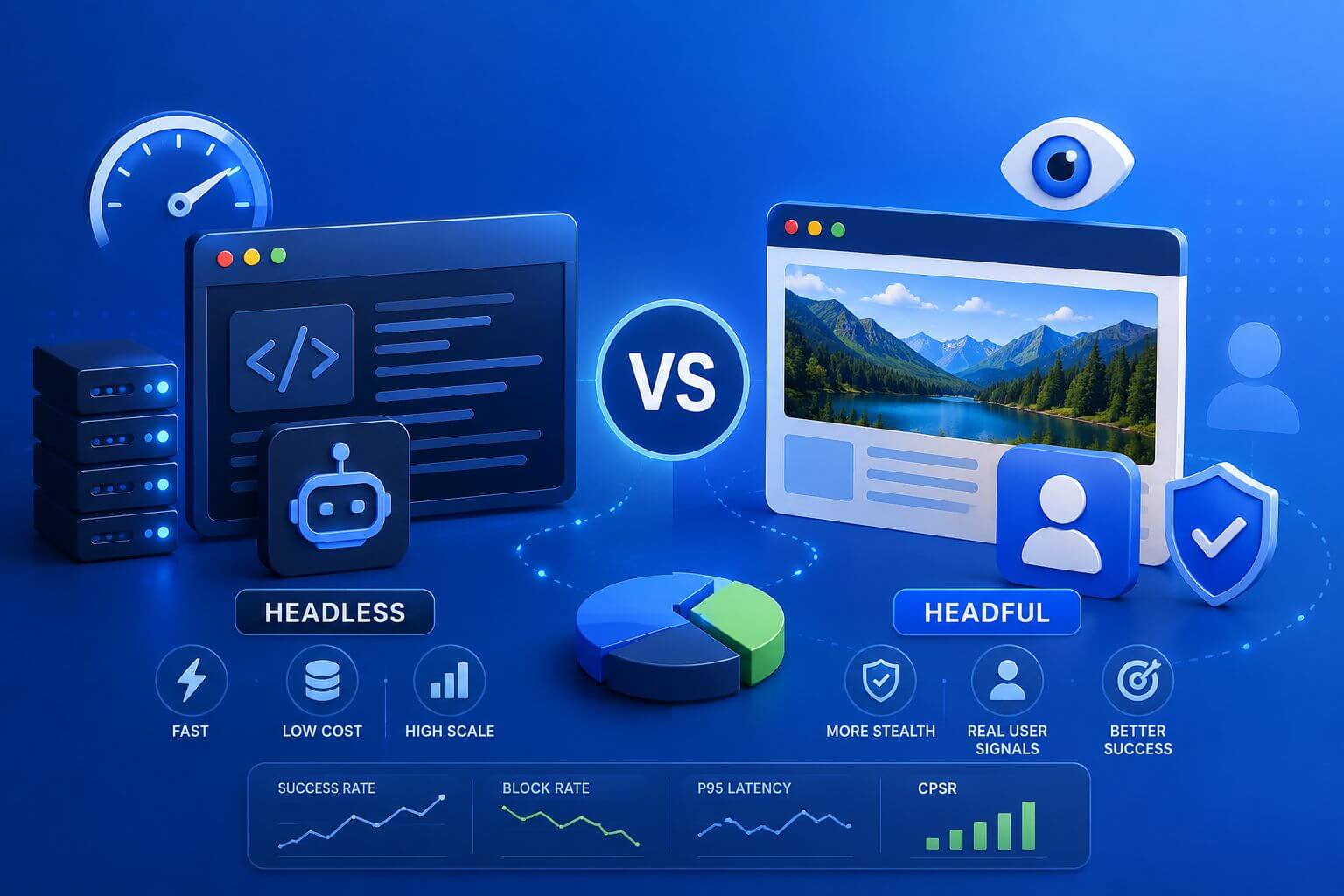
Headless vs Headful Browsers in Modern Scraping: How to Choose
A practical, metrics-driven guide to choosing between headless and headful browsers for modern web scraping, with decision frameworks, real-world scenarios, tuning tips, and what to measure.

Browser Fingerprinting for Web Scraping: What Proxies Can and Cannot Fix
A practical guide to browser fingerprinting in web scraping and the exact problems proxies can and cannot solve. Includes decision frameworks, failure modes, metrics to monitor, and real-world scenarios for teams running scraping, automation, and data collection at scale.

WebRTC Leaks: Why They Break Anti-Detect Setups
A practical guide to WebRTC leaks: how they expose real IPs behind proxies, why they trigger anti-bot flags, and how to prevent them across browsers and automation stacks—with clear decision paths, configuration tips, and metrics to monitor.